Music Theory: Lesson 1
Basic Twelve Note Division of the Octave
By Zack Cart
Music theory is a broad, and far
reaching subject. From the basic key-center understanding which helps when
composing a singer-songwriter style folk-rock tune by ear, to complex, computer
based pitch analyses in microtonal orchestral music, to the North Indian Rāgas and Tálas, or Byzantine
Church tetrachords, to nearly any arrangement of noise you can consider -- the
term "music theory" encompasses exponentially too much for any one
mind to consider.
Western music theory alone, is still too much.
Many people get discouraged in the first few attempts at understanding the most
basic elements. When these simplest of building blocks seem so incredibly
convoluted and nonsensical, the assumption that your brain is simply, "not
set up" to learn it, is a reasonable one. However, don't worry! Music
theory doesn't make sense. It is convoluted. the problem is not
with you, it lies in the fact that Western music has evolved throughout the
ages until no longer resembles its source, and yet the same theoretical systems
are continuously adapted to explain it. Imagine trying to understand French, by
use of a French dictionary in which all the definitions are in a mixture of
12th century Slavic dialects. It would be pretty tricky, huh? You'd feel like
there was something you just weren't getting, but the problem would be in the
ridiculous structure of the material, not in your head.
So, if you find music theory intimidating, just
relax, take it slow, and feel free to spend days or weeks struggling to master
a basic concept. Don't panic! And please, if something doesn't make sense, keep
re-working it until it does, don’t just move one. That way lies a half-baked
understanding which will inhibit a true understanding, and prevent clear
communication with musicians who DO take the time to learn the system.
That said, these lessons will be technical, but
I will try to make them palatable as well. Do NOT try to read straight through
and expect to learn everything. Take each idea individually, and learn it well
before continuing. Here we go.
Many of you probably wish to learn theory as an auxiliary to your primary instrument, rather than as an end in itself; this is fine, but if your instrument of choice is voice, guitar, drum-set, violin, zither, or anything that is NOT a standard Piano, I'd advise you to get either a keyboard of some sort, or regular access to one. Most musical instruments do not pair well with theory: Piano is based on theory. If you do not have your own keyboard, there are a number of free, virtual, online keyboards around, which can be easily searched out. While not ideal, they will serve to realize the theoretical concepts in actual audio for your more complete comprehension.
The strongest commonality between nearly all musical traditions is the octave. I will go briefly into why this is so, and what an octave is, in a bit, but first, let's familiarize ourselves with how an octave sounds. Pick any key on the keyboard. Play it a bunch. If you don't know the name, this is fine. Now, study the repeating pattern of large, white keys, and small, raised, black keys. Find another key which occupies the same position in the pattern elsewhere on the keyboard. Play both notes simultaneously. They sound almost like one note, huh? This is an octave. Find four notes which all occupy the same place in the pattern, play them, and they still sound almost like a big, fat, single note. These are all octaves.
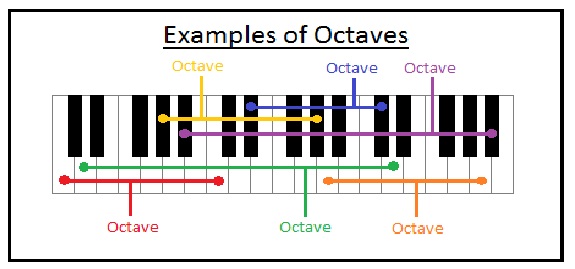
Now, play some groupings of notes which hold different places in the pattern. They should sound like different notes to you; these are not octaves.
To better understand what an octave is, and why it sounds so cohesive, we will have to go briefly into an extreme simplification of some basic acoustics. Sound is a series of pressure waves in matter, which pressurize our eardrums and send signals to our brains, which are then interpreted as the brain-generated "noises" we hear. Generally, when discussing sound, we are concerned with how it moves through air, but will travel in any other form of matter as well, some more effectively, and some less.
When an object vibrates, it displaces the air around it. if you picture the molecules, you can imagine them getting jammed together as the object pushes them, and then relaxing back as the object recoils away. These molecules in turn push at and recoil from their neighbors, creating the aforementioned pattern of high and low pressure zones. Try to picture this clearly before we move on.
Now, the pattern of vibration and pressure waves is an extremely complex combination of simple patterns. This is a fascinating subject, but for now, let's just understand that there are many simple patterns of pressure at varying speeds and intensities. When octaves are played, many of the most intense patterns are found in both notes, which is why they sound so cohesive. This is a gross oversimplification, and at a later date, we may go further into the depths of the octave. Right now, just accept that sound is a bunch of patterns of pressure traveling through the air (or other matter) and that both notes in an octave contain very similar patterns, and thus, sound similar.
Back to the keyboard -- if you find an octave relationship, one that will fit under one stretched hand, you will notice that that there are, counting the first note, twelve different notes until we reach the octave, and that from there, the same pattern repeats itself. There are many speculative and imaginative histories as to why we have twelve notes in an octave in western theory, some acoustics based, some tradition based, but what is important to know for now, is that the western octave contains twelve notes, and that this is somewhat arbitrary. (Other cultures use 17, 22, 24 notes, etc.) Even the twelve notes we now use, are different from those originally used. However, all these systems use the octave as the basis, just because it naturally sounds so "right." It is only the division of the octave which varies.
So, to continue familiarizing yourself with this fundamental musical concept, keep playing with octaves on the keyboard. Notice that, if you play an octave, and then move both notes in the same direction by the same number of keys, you still have an octave. Once you have gained a certain level of comfort with octaves on the keyboard, see if you can transpose this practical understanding to your primary instrument -- assuming that it is not piano -- and to your voice. Play the first note, sing it; play the second note, sing it; play the first note, then second, and then sing them both; and so on. Be creative!
Experiment, explore, have fun, and base that fun around familiarity with the sound and basic understanding of the octave.