This lesson has been brought to you by:
Maine's Largest bridal store
in business for 30 years
We carry thousands of bridal gowns from most designers.
Some gowns are our exclusive designs.
We also carry mother-of-the-bride gowns, bridesmaids dresses, prom and pageant, christening, and first communion dresses.
We sell and dye shoes.
We also provide tuxedo rentals and purchase.
We are open by appointments only.
Call today to make your appointment.
Email: pbuckbride@aol.com
Phone: (207) 622-6224

Guitar: Lesson 8
“Campfire” Chords of C Major
By Zack Cart
Prerequisites:
You should be able to understand and perform the concepts and techniques outlined in the following lessons before attempting this lesson:
Guitar: Lessons 1-7
Music Theory: Lessons 1-8
--------------------------------------------------------------------------------------------------
In this lesson we will go over, in detail, what are most likely the most common chords of the guitar. These chords form the basis of American folk, country, rock, and pop guitar, as well as traditional Flamenco, and even many of the simpler pieces in the classical repertoire.
As these chords are so common to popular and folk musics, and are also quite easy to learn and play, they are frequently (and often disparagingly) referred to as campfire chords. Although they are at times clumsy, limited, and frequently none-to-exciting to the ear, they are an excellent starting point for a guitarist in any style of music, and as such, they will be our first concrete foray into chord playing.
In “Music Theory: Lesson 8 - The Diatonic chords,” we learned how to derive a set of chords from any given key. In this lesson, we will apply this knowledge to the first three frets of the guitar, and discover a small set of simple, easy guitar chords, which we can use to harmonize many popular songs, and play them “around the campfire.” (Or living room, kitchen, concert stage, etc!)
First, we find the chords of C Major and their corresponding notes. If you are unsure of how this is done, please go back and study the Theory Lessons up to Lesson 8.
Triadic Chords of C Major
C Major - C E G
D minor - D F A
E minor - E G B
F Major - F A C
G Major - G B D
A minor - A C E
B diminished - B D F
Right of the bat, I will eliminate B diminished from the list, as it is both more difficult to play, and also infrequently-enough used in popular music that you are likely to need it immediately. (We will come back to it a MUCH more complex and physically difficult chords, I promise!)
Also, I will add on chord to list, which may seem strange, as it is out of key. However, for reasons to be discussed in the future, this chord works very well with the key, and in some respects is actually part of it. More on this later, again, I promise. This mysterious chord is E Major.
In all the following chords, keep all the notes within the first three frets of the guitar, and be sure to utilize open strings as much as possible. This will keep the chords as simple to play as possible. Also, keep in mind all the tenets of chord playing which we have already examined.
Try to learn a chord shape well, by playing it repeatedly, and holding it for periods of time while strumming. Also, switch between the chords you have learned in as many different patterns as you can think of. In all cases, strive to move all fingers at once, not mute required strings, and keep the transitions from one chord to the next as seamless as possible.
E minor
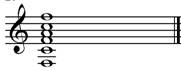
E minor is the simplest “campfire” chord of C major to play, so it will serve as our starting chord. Examining the notation below, you will notice that it requires only two fretted notes, a B and an E, the other notes can all be achieved through open strings. In order to achieve smoother transitions to later chords, play the B with your middle finger, and the E with your ring finger. Keep these fingers touching each other, and the others hovering, relaxed, just above the fretboard.
A minor
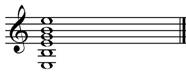
A minor has a simple chord/finger shape, if you have learned E minor well. Simply move the fingers which were playing B and E in the E minor chord both up a fret to E and A, and drop the pointer finger down on the C. The other three notes are achieved through open strings.
E Major
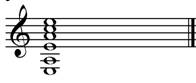
If you have thoroughly learned A minor, E Major should pose absolutely NO challenge to you. I will leave you to figure out why…
You will notice that this chord sounds the most ordinary when followed by A minor, and is relatively awkward when preceded by E minor. Also, you will find it to be the most flavorful of the current chord set, when played in the context of the other chords.
D minor
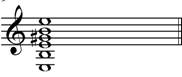
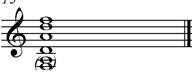
D minor may create more physical difficulties than any of the other previous three chords. You will note that the lowest note of the chord, F, is parenthetical. This is an optional note. By playing it, you manage to get every string involved in the chord, removing the need to avoid hitting the low E-string. However, fretting this low F can be quite difficult. I’m certain you can figure out how the A minor/E Major shape can very slightly modified to play the top three notes of the chord, D, A, and F. If you do, your thumb can be looped around the neck to “grab” the Low F. Alternatively, the top three notes may be played with the ring, pinky, and middle fingers, from lowest to highest, and the pointer can fret the low F.
The last option is to exclude this troublesome low F from the chord, and either to make sure not to strum it, or to touch the string gently with the thumb so as to keep it from ringing, if accidentally hit, or set into motion due to the vibrations of certain of the other notes in the chord. (More on this phenomenon later on)
C Major
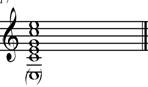
The easiest way to become comfortable with the C Major chord notated below, is to begin with an A minor chord, and move the ring finger from its place on A to the C in the Major chord. This chord should pose little difficulty for you.
Here again, we find a parenthetical note, this time the Low E. This note is easy to achieve, but may offset the harmony of the chord. The choice to play it or exclude it is an aesthetic one, an I leave it up to you.
G Major
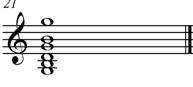
This chord is not exceptionally difficult, but it may create a stretch for your hands, at first. While many people resist using their pinkies at first, they ARE in fact necessary to competent guitar playing, and WILL be used in this chord shape. DO NOT substitute your ring finger! Use your middle finger for the lowest G, your pointer for the B, and your pinky (yes, pinky) for the highest G.
F Major
This chord, you will hate. For quite some time. Many people forgo learning the full chord shape, and play only the top four notes. However, this shape will become among the absolute MOST useful shapes for triadic chords a bit later, and you will learn how to turn it into up to TWELVE different chords, and through a several tiny alterations, at least 36 others. So. Learn it now, you won’t regret it!
You will note, upon examination, that SIX notes need to be fretted, yet we have only four fingers with which to accomplish this. (five, if you use your thumb, but we won’t be doing so) What needs to happen is the following;
Your ring finger will fret the lower of the two Cs.
Your pinky will fret the F above this C.
Your middle finger will fret the A.
Now for the difficult part. Your Pointer finger will fret the Lowest F, the higher C, and the Highest F. All of them! To do this, put the finger across all six frets, fretting with the edge of the entire finger. Make certain that all three notes are sounding clearly as a result. This will be easier if you use the surface of your finger halfway between the palm-side and thumb-side of the finger, and attempt to keep the creases of your knuckles in between strings. Good luck! With perseverance, you can learn this chord.
The practice of playing more than one note by utilizing the side of the finger is known as the Barre, although many people will use an English homonym, “Bar.” Whether you call this chord a Barre chord or a Bar-chord, the technique is the same.